Playing around with words and adding a few similes and rhymes can turn even a mundane idea into enjoyable poetry. Isn't it!
Art is nothing but a painted poetry
An artist is viewing the same scenes which everyone else is. But his artistic eye functions as a filter. It chooses in the scene only the elements which will enhance the intended experience of the audience..
Art is nothing but a painted poetry
An artist is viewing the same scenes which everyone else is. But his artistic eye functions as a filter. It chooses in the scene only the elements which will enhance the intended experience of the audience..

Let me illustrate this artistic filtration and composition decision with a recent painting I did.
 |
Picture credit - Raghu, The Hindu |
So, the other elements in the photo should not disturb my central theme. I have to retain only the elements which will support my central theme. Right?
 |
| The elements which are not necessary for my central theme |
Major Composition decision
I felt that my painting need not follow the horizontal landscape mode of the reference photo. My hunch was a vertical Portrait mode will make the painting different and make it more 'energetic'!
That will also enable to me show the full reflection of the jumping kid, which will make the aesthetics complete.
I felt that my painting need not follow the horizontal landscape mode of the reference photo. My hunch was a vertical Portrait mode will make the painting different and make it more 'energetic'!
That will also enable to me show the full reflection of the jumping kid, which will make the aesthetics complete.

Some more composition decisions which are subtle but effective
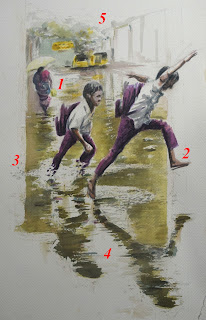 1. The reflection of the sky starts from the top and flows down as a light streak. This is the holding element for all the elements in the composition.
2. The jumping boy's foot protrudes outside the frame, giving a 3D effect depth.
3. Similarly the water splash breaks the frame on the other side.
4. The water around the boys' reflection was deliberately not painted. The isolated boys' reflections in the foreground adds a dramatic effect.
5. The background rectangle is not complete like a frame. It has been broken at the top and bottom to give a 'open feel'.
The responsibility of an artist is not to replicate reality. In contrast, he should filter the 'essence', add artistic elements to give an aesthetic experience to the viewer. That is the responsibility of an artist.
 1. The reflection of the sky starts from the top and flows down as a light streak. This is the holding element for all the elements in the composition.
2. The jumping boy's foot protrudes outside the frame, giving a 3D effect depth.
3. Similarly the water splash breaks the frame on the other side.
4. The water around the boys' reflection was deliberately not painted. The isolated boys' reflections in the foreground adds a dramatic effect.
5. The background rectangle is not complete like a frame. It has been broken at the top and bottom to give a 'open feel'.
The responsibility of an artist is not to replicate reality. In contrast, he should filter the 'essence', add artistic elements to give an aesthetic experience to the viewer. That is the responsibility of an artist.
- KravMaga SreeRam